
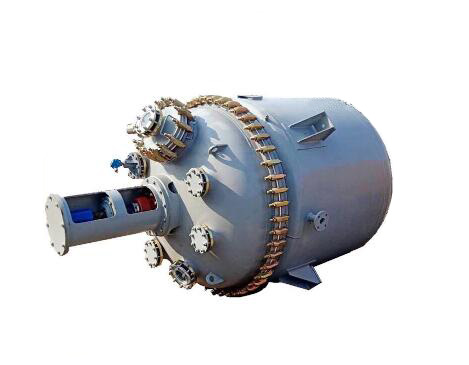


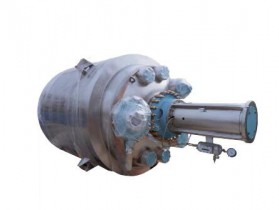
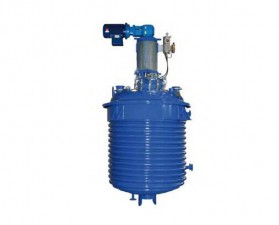
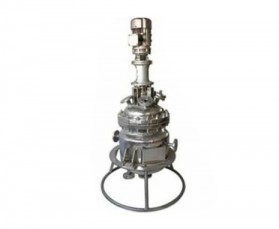


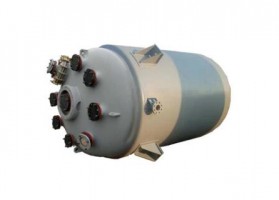
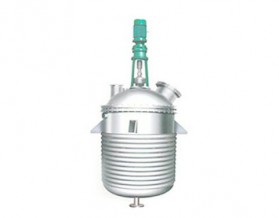
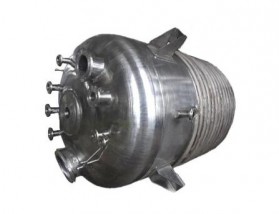
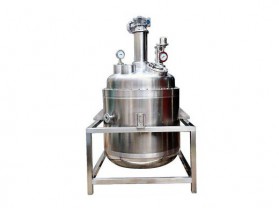

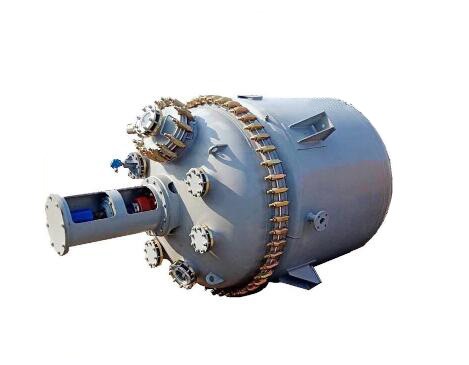
Benefits of Chemical Reactor
Efficiency
Chemical reactors maximize continuous processes to convert reactants into products quickly. Their efficient operation results in higher yields and throughput compared to batch reactors. Reactors can be designed for optimal temperature profiles, mixing, and flow patterns to improve kinetics and enhance reaction rates.
Quality Control
Careful control of temperature, pressure, residence time distribution, mixing intensity, and other critical parameters within the chemical reactor improves product quality consistency. Automated process controls with feedback loops allow tight regulation of conditions for high-purity output.
Consistent Quality
The continuous operation of chemical reactors with steady-state conditions enables very consistent product quality compared to batch reactors. Maintaining stable operating parameters like temperature and flow rates leads to uniform product specifications over long production runs.
Reduced Waste
Optimized reaction conditions inside chemical reactors minimize side reactions, by-products, and impurities, resulting in less waste. Continuous processing reduces downtime and the need for reactor cleaning between batches, lowering wastewater generation.
Energy Conservation
Heat integration within the chemical reactor system helps conserve energy by recycling waste heat through heat exchangers. Optimized reaction rates enabled by reactors also lower energy usage by minimizing heating/cooling needs.
Type Of Chemical Reactor
Batch Reactor
A batch reactor is a non-continuous form of reactor consisting of a closed vessel wherein reactions occur. Initially, all of the reactants are added to the reactor simultaneously. Batch reactors usually have an agitator that mixes the reactants thoroughly to execute the reaction and synthesize the product effectively.
Continuous Stirred Tank Reactor
A continuous stirred tank reactor (CSTR) is also known as a mixed flow reactor. In this reactor, the reaction takes place in a closed tank. An agitator is also included in the tank to make sure that the reactants are well mixed.
The reactants enter the reactor at a constant flow rate, react within the vessel for a time indicated by the space-time of the reactor, and then produce products. All products flow out of the reactor at the same time. The time it takes to execute one reactor volume is equivalent to one space-time.
Semi-Batch Reactor
A semi-flow reactor is a batch reactor modification. It is a closed vessel with an agitator to mix the reactants. One reactant is completely charged in the reactor initially, while the other is charged after regular time intervals. So, one chemical reactant is filled into the reactor, and the other chemical is added slowly (e.g., to prevent side reactions), or a product formed by a phase transition is continuously separated, such as gas formation during the reaction, precipitation of solids, or formation of hydrophobic product.
Catalytic Reactor
Catalytic reactors are frequently deployed as plug flow reactors; however, their calculations demand a more complicated technique. The amount of catalyst that the reagents come into contact with and the concentration of the reactants determine the catalytic reaction rate. A catalytic reaction pathway frequently happens with chemically bound intermediates in numerous phases. The kinetics may be affected by the chemical bonding to the catalyst, which is itself a chemical process. Catalytic processes commonly display so-called faked kinetics, in which the perceived kinetics vary from the true chemical kinetics due to physical transport factors.
Application of Chemical Reactor
Chemical reactors exist in such a wide range of forms and types that a complete sys-tematic classification is impossible. Two main categories that can be distinguished are homogeneous and heterogeneous reactors. In homogeneous reactors,only onephase, usually a gas or a liquid, is present. If more than one reactant is involved,provision must be made for mixing them together to form a homogeneous mixture.Another kind of classification, which cuts across the homogeneous–heterogeneous division, is the mode of operation,batchwise or continuous.
Homogeneous batch re-actions are carried out in vessels, tanks or autoclaves in which the reaction mixture isagitated and mixed in a suitable manner. This operation is familiar to anybody whohas carried out small-scale preparative reactions in the laboratory. Continuous flow reactors for homogeneous reaction systems already show a much greater va-riety. Predominant forms are thetubular reactorand themixed tank reactor,which have essentially different characteristics.In heterogeneous reactors, two or more phases are present.
The classification of reactors for heterogeneous systems shows a great number of possibilities. The dominant factor is the contact between the different phases. This leads to a classification of reac-tors as a contact apparatus. Common examples are gas–liquid, gas–solid, liquid–solid,liquid–liquid and gas–liquid–solid systems. In many cases, the solid phase is present as a catalyst.Gas–solid catalytic reactors comprise an important class of heteroge-neous chemical reaction systems. Generally, heterogeneous reactors exhibit a greater variety of configurations and contacting patterns than homogeneous reactors.
Associated with every chemical change, there is a heat of reaction that is only in a few cases small enough to be neglected. The magnitude of the heat of reaction has often a major influence on the design of a reactor.
 E-mail:info@cmchemical.net
 Tel:182-6588-8777
 Address: Room 804, Huaxia International Building, No.96 Liuquan Road, Zhangdian District, Zibo City, Shandong Province, P.R.China.
Shandong PIONEER Heavy Industry Technofogy Co., Ltd.
 E-mail:
 Tel:
Tel: